Showing posts with label Gabriel. Show all posts

Saturday, March 20, 2010

THE BIRTH OF JOHN THE BAPTIST FORETOLD


Angel Gabriel and Zechariah by Julius Schnoor von Carolsfeld, 1852-1860


[The Temple in Jerusalem B.C. 6]
Luke 1:5-25
There was in the days of Herod, the king of Judaea, a certain priest named Zacharias [which means YAHWEH Remembers], of the course [priestly division] of Abia [or Abijah]: and his wife was of the daughters of Aaron, and her name was Elisabeth [Elisheva: meaning -My God is abundance]. And they were both righteous before God, walking in all the commandments and ordinances of the Lord blameless. And they had no child, because that Elisabeth was barren, and they both were now well stricken in years.
And it came to pass, that while he executed the priest's office before God in the order of his course, according to the custom of the priest's office, his lot was to burn incense when he went into the temple of the Lord. And the whole multitude of the people was praying without at the time of incense.
In 1 Chronicles 24, King David divided the priesthood into twenty-four orders. Zachariah was serving in the order of Abijah (Abia). This was the eighth in sequence of the twenty-four orders. Each order served in the temple twice a year for one week each time. They would move to Jerusalem and live together during their period of service.
People have attempted to date the birth of John and the birth of Jesus based on this information. (I admit I tried this myself.) However, dating is difficult. I am of the mind God choose to obscure the actual dates so we wouldn’t become fixed on dates and not the personage. (See “A problem with Dates.)
But since we know the orders served in rotation and Abijah was eighth in the rotation, we think we can pinpoint when Gabriel visited Zachariah and deduce John’s birth from that and then because John is six months older than Jesus, infer Jesus’ birthday.
We could if calendars were exact measurements. Traditionally, the priestly rotation began in the Hebrew month Nissan, which would be mid-March to mid-April. Zachariah’s division would have thus served at the end of Iyyar (mid-April to mid-May) and Marheshvan (mid-October to mid-November). This is the rub. The Jewish calendar was twelve months long, but based on moon cycles, not the rotation around the Sun. The year was 354 days long, 11 days shorter than our solar calendar. Periodically, the Jews added an extra month after Adar, to make up the difference. This result in extra service and caused the service periods to fluctuate from year to year. Without knowing a specific year, it becomes impossible to know exactly when Zachariah was serving when Gabriel appeared.
We do know Zachariah had the great honor of burning the incense that day. This was an honor a priest only received once in his lifetime and it was chosen  by lot.
And there appeared unto him an angel of the Lord standing on the right side of the altar of incense. And when Zacharias saw him, he was troubled, and fear fell upon him. But the angel said to him, “Fear not, Zacharias: for your prayer is heard; and your wife Elisabeth shall bear you a son, and you shall call his name John [Yochanan: YAHWEH is gracious].
“And you shall have joy and gladness; and many shall rejoice at his birth. For he shall be great in the sight of the Lord, and shall drink neither wine nor strong drink; and he shall be filled with the Holy Ghost, even from his mother's womb. And many of the children of Israel shall he turn to the Lord their God. And he shall go before him in the spirit and power of Elias [Elijah], to turn the hearts of the fathers to the children, and the disobedient to the wisdom of the just; to make ready a people prepared for the Lord.”
And Zacharias said to the angel, “Whereby shall I know this? For I am an old man, and my wife well stricken in years.”
And the angel answering said to him, “I am Gabriel, that stand in the presence of God; and am sent to speak to you, and to show you these glad tidings. And, behold, you shall be dumb, and not able to speak, until the day that these things shall be performed, because you believed not my words, which shall be fulfilled in their season.
Gabriel had appeared in the Old Testament to Daniel to interpret visions (Daniel 8:15-17 and Daniel 9:20-22). He is to appear again to Mary to tell her she will give birth to Christ. He is considered one of the four archangels. The name Gabriel means “Strong Man of God”.
There are three Archangels named in the Bible. Gabriel, who seems to bring prophesy to humans each time he appears. The name means “Strong man of God”. The name appears four times, twice in Daniel and then Twice in Luke, where he appears first to Zachariah to announce he will father John the Baptist and then to Mary to tell her she will give birth to the Messiah. In Daniel 8 and 9, Gabriel explains to Daniel the meaning of future visions
(It is Islamic tradition that Gabriel visited Muhammad on Mount Hira and this meeting led to future revelations that became the basis of the Qur’an.)
The second Archangel is Michael, meaning, “who is like God”. Also Michael is first mentioned in Daniel, as well as in Jude and Revelation. He always seems to be engaged in battle with the Devil and his demons.

A CONTROVERSIAL THEORY
The Devil is the third named Archangel, the fallen one, who became known as Satan and the Dragon, among other names. There is one place, Isaiah 14:12, he is referred to as Lucifer, meaning “light-bearer” or “Morning Star”.  However, the Hebrew word translated in the literal is “shining one” and it comes from a root that can mean boasting or boastful.
Compare “How art thou fallen from heaven, O Lucifer, son of the morning! How art thou cut down to the ground, which didst weaken the nations!” Isaiah 14:12 to 2 Peter 1:19,  “And we have the word of the prophets made more certain, and you will do well to pay attention to it, as to a light shining in a dark place, until the day dawns and the morning star rises in your hearts.” The Greek translated “Morning Star” in English would be translated “Lucifer” in Latin, but the verse in 2 Peter refers to Christ. If we translate Isaiah 14 more literally we would get, “O shining one [or boastful one], son of the dawn!” Some make the case that the name Lucifer is another name applied to Christ as the Morning Star. That Satan’s name was Heylel, one who once bore the reflective light of the dawn; that is, Christ his creator, but boasted of it as if he were the light bearer and not simply its reflection.

And the people waited for Zacharias, and marveled that he tarried so long in the temple. And when he came out, he could not speak to them: and they perceived that he had seen a vision in the temple: for he beckoned to them, and remained speechless.
And it came to pass, that, as soon as the days of his ministration were accomplished, he departed to his own house. And after those days his wife Elisabeth conceived, and hid herself five months, saying, “Thus has the Lord dealt with me in the days wherein he looked on me, to take away my reproach among men.”
The people were wondering what was taking him so long. There are bells sews in the hem of his robe, so they probably heard him move about. (There is a myth that the priest had a rope tied about his ankle in case he died. This would allow people to pull him out of the place. This is not true and has no scriptural basis.) When he did come out there was no doubt he had seen a vision.
It is not certain how long afterward Elizabeth became impregnated. It is not certain which day Zachariah served. He would have to serve out his week and then travel home. This trip may have been a couple days long.
Elizabeth, who was a descendent of Aaron, and of the Priestly family of Levites, had never been able to have children. We don’t know if it was her problem or his, but in those times it was always considered the woman’s problem. There was a certain stigma to being barren, which is why she says God took away her reproach.
This has personal meanings for me. My wife could not have children (we lost seven) and she had been told it was impossible for her to have a child. When I became a Christian at age 34, with the prayer of a church and the mercy of God, we had three children. Miracles are very real to me because I experienced them.

THE BIRTH OF JESUS FORETOLD


The Annunciation by Henry Ossawa Tanner's, 1898

(Nazareth in Galilee Late B.C. 6 or early B.C 5)
Luke 1:26-38
And in the sixth month [referring to the sixth month of Elizabeth’s pregnancy] the angel Gabriel was sent from God to a city of Galilee, named Nazareth, to a virgin espoused to a man whose name was Joseph [Yosef:  meaning he will add], of the house of David; and the virgin's name was Mary [Miryam: Most likely is derived from Egyptian mry or beloved].
And the angel came to her, and said, “Hail, you that are highly favored, the Lord is with you: blessed are you among women.”
And when she saw him, she was troubled at his saying, and cast in her mind what manner of salutation this should be.
And the angel said to her, “Fear not, Mary: for you have found favor with God. And, behold, you shall conceive in thy womb, and bring forth a son, and shall call his name JESUS. He shall be great, and shall be called the Son of the Highest: and the Lord God shall give to him the throne of his father David: and he shall reign over the house of Jacob for ever; and of his kingdom there shall be no end.”
Then said Mary unto the angel, “How shall this be, seeing I know not a man?”
And the angel answered and said to her, “The Holy Ghost shall come upon you, and the power of the Highest shall overshadow you: therefore also that holy thing which shall be born of you shall be called the Son of God.”


THE PROMISES FULFILLED
And I will put enmity between you and the woman, and between your offspring and hers; he will crush your head, and you will strike his heel." Genesis 3:15

Then Isaiah said, "Hear now, you house of David! Is it not enough to try the patience of men? Will you try the patience of my God also? Therefore the Lord himself will give you a sign: The virgin will be with child and will give birth to a son, and will call him Immanuel. Isaiah 7:13-17

But you, Bethlehem Ephratah, though you be little among the thousands of Judah, yet out of you shall he come forth to me that is to be ruler in Israel; whose goings forth have been from of old, from everlasting. Therefore will he give them up, until the time that she which travails has brought forth, then the remnant of his brethren shall return to the children of Israel. And he shall stand and feed in the strength of the LORD, in the majesty of the name of the LORD his God; and they shall abide for now shall he be great to the ends of the earth. And this man shall be the peace, when the Assyrian shall come into our land and when he shall tread in our palaces then shall we raise against him seven shepherds, and eight principal men. Micah 5:2-5

MARY VISITS ELIZABETH


Mary’s Visit to Elisabeth by Carl Heinrich Bloch, circa 1850

(Judea Early B.C. 5)
Luke 1:39-56
And Mary arose in those days, and went into the hill country with haste, into a city of Judea [a distance of 90 to 120 miles]; and entered into the house of Zacharias, and saluted Elisabeth.
And it came to pass, that, when Elisabeth heard the salutation of Mary, the babe leaped in her womb; and Elisabeth was filled with the Holy Ghost: and she spoke out with a loud voice, and said, “Blessed are you among women, and blessed is the fruit of your womb. And whence is this to me that the mother of my Lord should come to me? For, lo, as soon as the voice of your salutation sounded in my ears, the babe leaped in my womb for joy. And blessed is she that believed: for there shall be a performance of those things which were told her from the Lord.”

We are told Mary hurried to Elizabeth home. This wasn't like going next door. Elizabeth lived perhaps a hundred miles away. It had to be a trip of a few days. We need to consider this. Gabriel had just informed Mary that she was going to bear God's Son. He also informed her that Elizabeth; a barren woman of advanced years was already pregnant.  Mary was a teenager, espoused to a man and living with her parents. Who would you or could you tell that an Angel had visited and said you were going to be pregnant yet a virgin? I think Mary went to her relative because she knew Elizabeth would believe her story, and perhaps, also would confirm the truth of it.  I don't know what she told her parents about making this trip and staying away for three months. Perhaps her visit to Elizabeth was viewed as assisting her cousin’s pregnancy. She stayed three months, so might have been present for the birth of John.
Elizabeth knew at once Mary's situation. How did she know? Scripture tells us. It was reveled to her by the Holy Spirit. She shouted her blessing on Mary for all to hear.  If Mary had any qualms, they were gone with Elizabeth's exclamation. We see Mary's great faith and humble spirit in her song, which is also called the "Magnificat". This title is simply the first word of her song in the Latin, which began: "Magnificat animum mea Dominum", "My soul magnifies the Lord". 
Mary's Song
And Mary said, “My soul does magnify the Lord, and my spirit has rejoiced in God my Savior. For he has regarded the low estate of his handmaiden: for, behold, from henceforth all generations shall call me blessed. For he that is mighty has done to me great things; and holy is his name. And his mercy is on them that fear him from generation to generation. He has shown strength with his arm; he has scattered the proud in the imagination of their hearts. He has put down the mighty from their seats, and exalted them of low degree. He has filled the hungry with good things; and the rich he has sent empty away. He has helped his servant Israel, in remembrance of his mercy; as he spoke to our fathers, to Abraham, and to his seed for ever.”
And Mary abode with her about three months, and returned to her own house.

In Mary’s Song we may get an insight as to why this maiden was chosen. It certainly shows knowledge of the Scriptures and understanding of God. It is worshipful and thankful. It contains references to eight separate psalms. [ 34, 71, 98 (twice), 103, 107, 111, 132 and 138.) This was a devout person. However, being devout, pious or religious is not enough to save one and Mary was as much in need of a Savior as any human. She begins her song rejoicing “in God my Savior”.
And yes, I am aware of the dogma of the “Immaculate Conception”, but no, I do not believe that Mary was born free of original sin. There is no basis for this belief in Scripture, a fact admitted by those who adhere to it: “No direct or categorical and stringent proof of the dogma can be brought forward from Scripture” (The Catholic Encyclopedia).  The defense of the dogma becomes rather strained and convoluted. The familiar words, “Hail, Mary, full of grace”, which begin the “Hail Mary Prayer” are taken from the Douay-Confraternity Bible translation of Like 1:28, “And when the angel had come to her, he said, ‘Hail, full of grace, the Lord is with thee. Blessed art thou among women’,” is said to indicate the godlike state of Mary’s soul. But the Confraternity is a translation of the Vulgate, which was a Latin version of the Bible. Going back to the Greek, the literal translation is more, “Hail, highly favored, the Lord with you.” This is stated in Young’s Literal Translation as, “Hail, favored one,” in the King James version as, “Hail, thou that art highly favoured”, in the New American Standard Version as, “Greetings, favored one” and in the NIV as, “Greetings, you who are highly favored”. Even being highly favored by God does not preclude the existence of your human nature, inclination toward sin and need for salvation.
We are told only salient details in Scripture. We do not know the reaction of Mary's parents upon her return. She was probably pregnant at this time. We can speculate based on our own reactions if our daughter went off for three month and came home pregnant. We certainly know suspicions were that she was a fallen woman. How so? We know from what we are told about Joseph's reaction and plans, until the Angel also comes to him. If Joseph thought the worse, her parents probably did as well. It must have been a very trying time for them.
Think of the strength of Mary’s faith. It is difficult for us to understand how strong she was because we live in Twenty-First century America. Anyone, even teenagers, getting pregnant outside of marriage is hardly uncommon or harshly condemned anymore.
Mary was not only facing ostracism; she was facing accusation of a capital offence.

If, however, the charge is true and no proof of the girl's virginity can be found, she shall be brought to the door of her father's house and there the men of her town shall stone her to death. She has done a disgraceful thing in Israel by being promiscuous while still in her father's house. You must purge the evil from among you. Deuteronomy 22:20-21. (NIV)

There would have been no way to hide the fact she was pregnant. Although most women do not show until they are four to five months with child, if Joseph and she married before that time, her loss of virginity would have been discovered on her wedding night. If the marriage were later, then the development of the baby would have exposed her first.
Mary could have claimed she had been raped in the country during her journey to Elisabeth’s home.

But if out in the country a man happens to meet a girl pledged to be married and rapes her, only the man who has done this shall die. Do nothing to the girl; she has committed no sin deserving death. This case is like that of someone who attacks and murders his neighbor, for the man found the girl out in the country, and though the betrothed girl screamed, there was no one to rescue her. Deuteronomy 22:25-27 (NIV)
(Although for this to be an acceptable explanation, she would probably have had to begin yelling she had been raped immediately upon meeting other people.
Mary, in her case, was only secure by the Grace of God.

THE BIRTH OF JOHN THE BAPTIST


Birth of John the Baptist by Giovanni di Paolo, circa 1454
(Spring B.C. 5)
Luke 1:57-79
Now Elisabeth's full time came that she should be delivered; and she brought forth a son. And her neighbors and her cousins heard how the Lord had shown great mercy upon her; and they rejoiced with her.
And it came to pass, that on the eighth day they came to circumcise the child; and they called him Zacharias, after the name of his father. And his mother answered and said, “Not so; but he shall be called John.”
And they said to her, “There is none of your kindred that is called by this name.” And they made signs to his father, how he would have him called.
And he asked for a writing table, and wrote, saying, “His name is John.”
And they marveled all.
And his mouth was opened immediately, and his tongue loosed, and he spoke, and praised God.
And fear came on all that dwelt round about them: and all these sayings were noised abroad throughout all the hill country of Judaea. And all they that heard them laid them up in their hearts, saying, “What manner of child shall this be!”
And the hand of the Lord was with him.

It was the tradition of Jews, and this went on for thousands of years, to name a child in honor of a deceased relative (although for some sects, the name could be of a living relative or a great Torah scholar).  After the Diaspora [the one following the destruction of the Temple in 70 AD until the 1948 reestablishment of Israel], when the Jews were scattered throughout the world and their land no longer theirs, began a tradition of double naming; that is, giving a Hebrew name and a secular name. Within their own enclaves they would use the Hebrew name, but in the culture they lived within they would use the secular name. But that was to come later, so it must have been a real shock when Zechariah insisted on the name John, whom no one in his family had been called. John means "God is gracious". 
God was about to be gracious indeed, about to show the world His Grace through the birth and death of Jesus. I also think the name set John the Baptist apart just as his lifestyle and mission was going to set him apart from other men.  
Zechariah's Song
And his father Zacharias was filled with the Holy Ghost, and prophesied, saying,
“Blessed be the Lord God of Israel; for he has visited and redeemed his people, and has raised up an horn of salvation for us in the house of his servant David; as he spoke by the mouth of his holy prophets, which have been since the world began: that we should be saved from our enemies, and from the hand of all that hate us; to perform the mercy promised to our fathers, and to remember his holy covenant; the oath which he swore to our father Abraham, that he would grant to us, that we being delivered out of the hand of our enemies might serve him without fear, in holiness and righteousness before him, all the days of our life.
“And you, child, shall be called the prophet of the Highest: for you shall go before the face of the Lord to prepare his ways; to give knowledge of salvation to his people by the remission of their sins, through the tender mercy of our God; whereby the dayspring from on high has visited us, to give light to them that sit in darkness and in the shadow of death, to guide our feet into the way of peace.”
Mary had been visited by Gabriel and told she would bear God's Son. She immediately went to visit her relative, Elizabeth, who lived some distance away and she stayed there for three months.
Here are a couple of things to consider. We were told in scripture it was the sixth month of Elizabeth's pregnancy when the Angel appeared to Mary, and Mary then stayed with Elizabeth for three months.  It seems quite reasonable that Mary was present at John the Baptist's birth and then came back home.  Perhaps this was her explanation to her parents for her journey, to tend to Elizabeth during the pregnancy and birthing.
Since Mary was not yet pregnant when she went to Elizabeth, we can logically assume Joseph's visitation occurred after her return. She probably was reveled as "with child" upon arrival back. This would look bad; of course, your teenage daughter goes away for three months and returns home pregnant. This was a very grave matter. One wonders if Elizabeth sent any message of support with Mary, since Elizabeth had experienced a miracle under similar circumstances of angelic visits. Elizabeth obviously understood and believed Mary's story. We don't know what Mary's parents thought of this, but we do know Joseph's reaction. He was distraught. 

JOHN’S FASHION AND DIET TIPS

JOHN’S FASHION AND DIET TIPS


Perhaps we should talk about John’s appearance and diet here.  I have seen several artists’ renderings of John the Baptist and some present a character out of the Flintstones, a Neanderthal of a man in a brief costume of fur. All he needs is a thick club resting on his shoulder and he could be Ally Oop.  In other paintings and some films, he is presented in an unruly long beard and a great bush of untamed hair as if performing a Wild Man of Borneo act in the circus sideshow.  Why would throngs of people come out to be baptized by such a creature? They’d more likely flee the other way thinking him possessed.
Scripture simply says he wore clothing made of camel hair and a leather belt around his waist. His clothing wove from camel hair didn’t necessarily have to look much different from what others wore.  Some Bible historians believe he wore a simple robe similar to and recognized as that worn by many Old Testament Prophets, for indeed, he was the last of these.
I rather imagine John was pretty clean; after all, he spent most of his day in water. His hair and beard may have been kept smoothed down by that element. Besides, nowhere in scripture does it say he was anymore hairy than anyone else. Some suppose he was a Nazirite because Gabriel had told Zechariah, “He is never to take wine or other fermented drink”.  But it is never said a razor will never touch his head. John MacArthur is one who claims John was a Nazirite, but nowhere in Scripture does it say John took such a vow. He may have had a well-trimmed beard and been bald for all we really know.
PORTION OF THE NAZIRITE VOW
The LORD said to Moses, "Speak to the Israelites and say to them: 'If a man or woman wants to make a special vow, a vow of separation to the LORD as a Nazirite, he must abstain from wine and other fermented drink and must not drink vinegar made from wine or from other fermented drink. He must not drink grape juice or eat grapes or raisins. As long as he is a Nazirite, he must not eat anything that comes from the grapevine, not even the seeds or skins.

" 'During the entire period of his vow of separation no razor may be used on his head. He must be holy until the period of his separation to the LORD is over; he must let the hair of his head grow long. Throughout the period of his separation to the LORD he must not go near a dead body. Even if his own father or mother or brother or sister dies, he must not make himself ceremonially unclean on account of them, because the symbol of his separation to God is on his head. Numbers 6:1-7 (NIV)

The other question about John concerns that Breakfast of Champions, locusts and wild honey.
We probably have no difficulty with the honey part. Honey is one of our oldest known foods, being mentioned as far back as 2100 BC; that’s BC, folks. Honey is “an organic, natural sugar alternative with no additives that is easy on the stomach, adapts to all cooking processes, and has an indefinite shelf-life.”
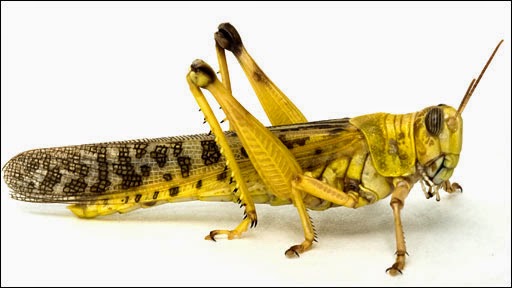
John the Baptist is living in the wilderness and is going to eat what is available and plentiful there. Grasshoppers or Locust (there is a difference, but most people wouldn’t make the distinction*** on seeing one, nor do the Gospel writers necessarily make one and translations sometimes say grasshoppers) are a common food in certain regions of the world. John probably found them delicious when sweetened by honey. The word translated as locust is “akris”.
 
Akris: a locust, particularly that species which especially infests oriental countries, stripping fields and trees. Numberless swarms of them almost every spring are carried by the wind from Arabia into Palestine, and having devastated that country, migrate to regions farther north, until they perish by falling into the sea. The Orientals accustomed to feed upon locusts, either raw or roasted and seasoned with salt (or prepared in other ways), and the Israelites also were permitted to eat them.

There are, however, some winged creatures that walk on all fours that you may eat: those that have jointed legs for hopping on the ground. Of these you may eat any kind of locust, katydid, cricket or grasshopper. But all other winged creatures that have four legs you are to detest. Leviticus 11:21-23 (NIV)

This all seems pretty clear, so why any question?
There are some who argue the word “Akris” was really “enkris”.  This mistake seems unlikely given the number of preserved Septuagint texts and all the many scholars who have translated and studied it. Surely, they would have picked up this error. Enkris means, “cake”. There was a Greek delicacy called Enkris, but John was in the desert, not at an Athens’ Starbucks having his latte and enkris.
Others argue what John was eating the fruit of the Locust Tree. This is an evergreen tree that
grows as high as fifty feet and in the spring produces a huge quantity of pods called Carob.  These pods are sweet inside (lot of sweet piling up here with the honey). In some parts of the East, these pods are called “St. John’s Bread” and people there believe this is what John the Baptist ate. And Carobs are dried and used as food for both cattle and people.
But I don’t think John was out there harvesting and drying Carobs, I think he was catching and nibbling the insect, perhaps roasted with a little salt or eaten raw with a dab of honey.  There is nowhere in the Septuagint where Akris means pod or anything other than the insect. When you read the Bible, stick to the simplest exclamation. Why make this a cause for vegetarianism?
There is nothing in the statement that “his food was locust and wild honey” that precludes John eating other things. At the time of his ministry he was pretty busy and these things were handy and easy to prepare. Growing up he probably ate the traditional kosher meals of his parents and even as an adult might have had occasion to supplement his regular limited diet. And since John would have been very exact in trying to obey God in all things, he surely took part in the required Ceremonies and Feasts, and eaten the Passover lamb. So, lets focus more on his purpose and his ministry than his mealtimes.

***It is very common for people in my area to call the cicada a locust, and to call actual locust, grasshoppers, since locust and grasshoppers look very similar. A cicada does not resemble either though.


 Cicada             


  Locust                  


Grasshopper