Showing posts with label Wine. Show all posts

Saturday, March 20, 2010

JOHN’S FASHION AND DIET TIPS

JOHN’S FASHION AND DIET TIPS


Perhaps we should talk about John’s appearance and diet here.  I have seen several artists’ renderings of John the Baptist and some present a character out of the Flintstones, a Neanderthal of a man in a brief costume of fur. All he needs is a thick club resting on his shoulder and he could be Ally Oop.  In other paintings and some films, he is presented in an unruly long beard and a great bush of untamed hair as if performing a Wild Man of Borneo act in the circus sideshow.  Why would throngs of people come out to be baptized by such a creature? They’d more likely flee the other way thinking him possessed.
Scripture simply says he wore clothing made of camel hair and a leather belt around his waist. His clothing wove from camel hair didn’t necessarily have to look much different from what others wore.  Some Bible historians believe he wore a simple robe similar to and recognized as that worn by many Old Testament Prophets, for indeed, he was the last of these.
I rather imagine John was pretty clean; after all, he spent most of his day in water. His hair and beard may have been kept smoothed down by that element. Besides, nowhere in scripture does it say he was anymore hairy than anyone else. Some suppose he was a Nazirite because Gabriel had told Zechariah, “He is never to take wine or other fermented drink”.  But it is never said a razor will never touch his head. John MacArthur is one who claims John was a Nazirite, but nowhere in Scripture does it say John took such a vow. He may have had a well-trimmed beard and been bald for all we really know.
PORTION OF THE NAZIRITE VOW
The LORD said to Moses, "Speak to the Israelites and say to them: 'If a man or woman wants to make a special vow, a vow of separation to the LORD as a Nazirite, he must abstain from wine and other fermented drink and must not drink vinegar made from wine or from other fermented drink. He must not drink grape juice or eat grapes or raisins. As long as he is a Nazirite, he must not eat anything that comes from the grapevine, not even the seeds or skins.

" 'During the entire period of his vow of separation no razor may be used on his head. He must be holy until the period of his separation to the LORD is over; he must let the hair of his head grow long. Throughout the period of his separation to the LORD he must not go near a dead body. Even if his own father or mother or brother or sister dies, he must not make himself ceremonially unclean on account of them, because the symbol of his separation to God is on his head. Numbers 6:1-7 (NIV)

The other question about John concerns that Breakfast of Champions, locusts and wild honey.
We probably have no difficulty with the honey part. Honey is one of our oldest known foods, being mentioned as far back as 2100 BC; that’s BC, folks. Honey is “an organic, natural sugar alternative with no additives that is easy on the stomach, adapts to all cooking processes, and has an indefinite shelf-life.”
John the Baptist is living in the wilderness and is going to eat what is available and plentiful there. Grasshoppers or Locust (there is a difference, but most people wouldn’t make the distinction*** on seeing one, nor do the Gospel writers necessarily make one and translations sometimes say grasshoppers) are a common food in certain regions of the world. John probably found them delicious when sweetened by honey. The word translated as locust is “akris”.
 
Akris: a locust, particularly that species which especially infests oriental countries, stripping fields and trees. Numberless swarms of them almost every spring are carried by the wind from Arabia into Palestine, and having devastated that country, migrate to regions farther north, until they perish by falling into the sea. The Orientals accustomed to feed upon locusts, either raw or roasted and seasoned with salt (or prepared in other ways), and the Israelites also were permitted to eat them.

There are, however, some winged creatures that walk on all fours that you may eat: those that have jointed legs for hopping on the ground. Of these you may eat any kind of locust, katydid, cricket or grasshopper. But all other winged creatures that have four legs you are to detest. Leviticus 11:21-23 (NIV)

This all seems pretty clear, so why any question?
There are some who argue the word “Akris” was really “enkris”.  This mistake seems unlikely given the number of preserved Septuagint texts and all the many scholars who have translated and studied it. Surely, they would have picked up this error. Enkris means, “cake”. There was a Greek delicacy called Enkris, but John was in the desert, not at an Athens’ Starbucks having his latte and enkris.
Others argue what John was eating the fruit of the Locust Tree. This is an evergreen tree that
grows as high as fifty feet and in the spring produces a huge quantity of pods called Carob.  These pods are sweet inside (lot of sweet piling up here with the honey). In some parts of the East, these pods are called “St. John’s Bread” and people there believe this is what John the Baptist ate. And Carobs are dried and used as food for both cattle and people.
But I don’t think John was out there harvesting and drying Carobs, I think he was catching and nibbling the insect, perhaps roasted with a little salt or eaten raw with a dab of honey.  There is nowhere in the Septuagint where Akris means pod or anything other than the insect. When you read the Bible, stick to the simplest exclamation. Why make this a cause for vegetarianism?
There is nothing in the statement that “his food was locust and wild honey” that precludes John eating other things. At the time of his ministry he was pretty busy and these things were handy and easy to prepare. Growing up he probably ate the traditional kosher meals of his parents and even as an adult might have had occasion to supplement his regular limited diet. And since John would have been very exact in trying to obey God in all things, he surely took part in the required Ceremonies and Feasts, and eaten the Passover lamb. So, lets focus more on his purpose and his ministry than his mealtimes.

***It is very common for people in my area to call the cicada a locust, and to call actual locust, grasshoppers, since locust and grasshoppers look very similar. A cicada does not resemble either though.


 Cicada             
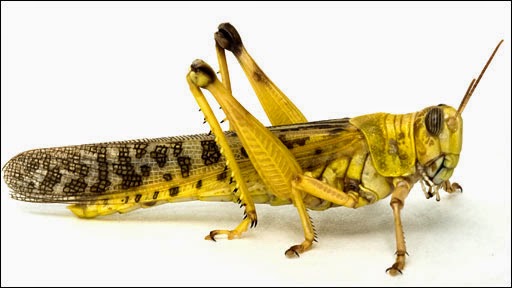

                  
  Locust                  


Grasshopper


JESUS AT THE WEDDING FEAST IN CANA

The Wedding at Cana by Jacopo Robusti Tintoretto, 1561

Autumn 26 A.D
Cana in Galilee

John 2:1-12
And the third day there was a marriage in Cana of Galilee; and the mother of Jesus was there and both Jesus was called, and his disciples, to the marriage.

On the map below, you will see Cana just above Nazareth and if you look further down to the Dead Sea, you will see a Bethany just at the top of the sea. As stated previously, no one  really knows 
the exact location of either of these places anymore. Their placement on this map is the most commonly accepted guess. It is thus estimated that Cana was about 9 miles north of Nazareth. The location of Bethany beyond the Jordan probably was just inside the border of modern day Jordan.
At any rate, there are those who claim Jesus could not have been at Bethany beyond the Jordan and then attended a wedding in Cana in the time frame given by John. However, this is a miscalculation of the text. When they read, “On the third day a wedding took place at Cana in Galilee”, they mistakenly think it is the third day after John the Baptist pointed Jesus out to John and Andrew. However, a careful count of the references to “the next day (as we did) shows Jesus decided to leave for Galilee on the third day and the reference of the wedding on the third day is the third day of that trip.
Some still argue the distance was too great, but this only comes from living in a culture and time when we ride everywhere. We are not use to walking great distances to go between places as was common in those times. The distance between Bethany and Cana was most likely 90 to 95 miles. I walk at an average rate of 4 miles per hour. If we allow a slower pace of three miles per hour, a person could cover the distance in three days by walking between 10 and 11 hours a day. If the person did average four miles per hour, it would be eight hours a day. For people used to foot travel, certainly doable. 
Here is where we pickup on the third day when Jesus and his new disciples arrive at this wedding:
And when they wanted wine, the mother of Jesus said to him, “They have no wine.”
Jesus said to her, “Woman, what have I to do with thee? My hour is not yet come.”
His mother said to the servants, “Whatsoever he says to you, do it.”
And there were set there six water pots of stone, after the manner of the purifying of the Jews, containing two or three firkins [8 or 9 gallons] apiece. Jesus said to them, “Fill the water pots with water.”
And they filled them up to the brim.
And he said to them, “Draw out now, and bear to the governor of the feast.”
And they bare it.

Mary says to Him (probably whispered). “They have no more wine.”  This was going to be a great embarrassment to the family running out of wine before all the wedding celebrating was over. I think Jesus and His disciples had just arrived when the wine ran out and so Mary informed Him of that fact. It would have been customary for Jesus and his followers to be given wine and perhaps this had not happened. If we look at the Young’s Literal Translation of this text it becomes clearer this may have been the sequence of events:
And the third day a marriage happened in Cana of Galilee, and the mother of Jesus was there, and also Jesus was called, and his disciples, to the marriage; and wine having failed, the mother of Jesus saith unto him, `Wine they have not…'

This may have been a family wedding. We find later that Mary, Jesus, His disciples and His brothers went down to Capernaum from there, so His brothers were also guests. Mary as a close family member may have been helping with the arrangements. It may also be this is why Jesus decided to go to Galilee when He did, he had been invited to this wedding. The literal translation says Jesus was called. His new disciples may have been called as a courtesy. These were not gatecrashers, one had to be invited to attend a wedding feast. We have to be called to attend the Wedding Feast of the Lamb. We won’t be allowed in with out our invitation.
Notice that Mary does not ask Jesus to do anything; she just states a fact. Jesus reply is curious, “Dear woman, why do you involve me? My time has not yet come.” (NIV) [Woman, what have I to do with thee? Mine hour is not yet come. (KJV)]
If his mother had called Jesus to the wedding and she had some responsibility for the provisions, was it inferred he would help by creating more wine?
The King James translation sounds harsh, “Woman what have I to do with thee?” The NIV sounds either indifferent or put-upon, “Dear woman, why do you involve me?” First, He is speaking to his mother and we would not today generally refer to our mother as “woman”. But in those times this was actually a term of respect. Second, there may have been a better translation of Jesus’ response. Here is the Young Literal Translation: “Jesus saith to her, `What -- to me and to thee, woman? Not yet is mine hour come.”
This may to be similar to us saying, “Mother, just between you and me, it isn’t my time yet.”
Mary never made a specific request and she doesn’t wait for a specific answer either. She goes to the servants and says to do what Jesus tells them. This again indicates Mary had some authority at this wedding, enough that the servants would obey her. Also notice this is all kept rather secretive. There are only three groups who witness what happens: Mary and Jesus, the servants and the disciples. There is no spectacle made of this first miracle. No one else is let in on it. Mary doesn’t boast, “Look everyone at what my wonderful son the Messiah can do.” Jesus doesn’t stand before the wedding guests and announce, “Watch this and be amazed.”
It isn’t time for that yet.
Jesus quietly points out some empty ceremonial washing jars and tells the servants to fill them with water. He doesn’t say to what purpose. He then tells them to draw some and take it to the banquet master, which they do. 
When the ruler of the feast had tasted the water that was made wine, and knew not whence it was (but the servants which drew the water knew) the governor of the feast called the bridegroom and said to him, “Every man at the beginning does set forth good wine; and when men have well drunk, then that which is worse, but you have kept the good wine until now.”
This beginning of miracles did Jesus in Cana of Galilee, and manifested forth his glory, and his disciples believed on him.

The banquet master had no idea a miracle had occurred. The biggest miracle in his eyes was the family had saved the best wine for last, something that just wasn’t done. Generally, it still isn’t. You serve the expensive wine first, and then you serve cheaper wine. Why? To save cost. When one first drinks a cup of wine, the taste buds are fresh and the drinker savors the drink, but after a cup or two, the taste is dulled to a point it is hard to distinguish a change in the drink. In the case of those times, the best wine would be served and then wine that was either a bit close to turning sour or new wine that had not fully fermented. 
There is a lesson here. Jesus honored his mother and saved the bridegroom’s family from embarrassment, but he took none of the credit. As far as the banquet master and the wedding guests were concerned, the bridegroom was a generous person. A true kindness from a generous heart is one unmotivated by self-aggrandizement or praise seeking. It is not self-serving. It is the right hand not knowing what the left hand does so the good deed done is between the doer and God. Mary didn’t have to actually ask, because she knew he would do it out of mercy. Jesus did it without fully revealing himself.
The servants had seen what happened, why didn’t they say something? Perhaps somewhere at sometime they did speak of it to intimate acquaintances they trusted not to ridicule them? Put yourself in their sandals. If you saw a man take a jug of water and turn it into fine wine, would you tell anyone? Who would believe you? Would you tell the banquet master, your boss? He might think you’d been sneaking the wine on duty and fire you on the spot. 
There was someone else Jesus allowed to witness this transformation of water into wine, the five new disciples he had chosen to bring with him from Bethany. Remember what was the last thing said to Nathanael before the trek to Cana began? "You believe because I told you I saw you under the fig tree. You shall see greater things than that." Here is the first of greater things these Disciples will see over the next three and a half years. It is also the first opportunity Jesus takes to manifest his glory to these men to teach them to put their faith in him.
As an aside, I read some believe this wedding was Nathanael’s. This doesn’t make much sense and seems only to come from the fact Nathanael is from Cana. However, if you notice after the banquet master receives this new wine (and don’t think the reception of new wine doesn’t have a far more spiritual and future meaning) he called the bridegroom aside to congratulate him. This would indicate Mary and Jesus were attending the wedding feast. This is an important fact.
Today when we think of attending a wedding it means going to a relatively short ceremony where the bride and groom exchange vows to each other. This is often followed by a joyride, a caravan of cars following the newly weds and blowing horns. This ends with a reception, where a meal is served, music is provided, often dancing and then the happy couple drive off to parts unknown for a honeymoon.
This is not the wedding procedure being followed in Cana in the First Century. First, the couple was for all intent and purpose “married” with their betrothal. This was not the same as our engagement period today. One did not simply decide to return the ring and try someone else. To end a betrothal one had to have legal reason to petition for a divorce. (This was the situation Joseph faced when Mary told him she was pregnant, whether to divorce her for adultery.) 
Once a woman had accepted the man’s proposal and the betrothal was established, the groom would tell his bride he was going to prepare a home for her and would return for her when it was ready. (Keep this in mind; it will come up again later in Jesus’ promises to those who believed in Him.) While he was busy building or preparing this home, she would be busy getting a number of things together by her bed for the moment he returned. When he came back, she would know it because he would come with his friends and there would be the blowing of a trumpet.
Here is why this could not have been Nathanael’s wedding. The groom would collect his bride and followed by the wedding guests and family, they would go to their new home for seven days, their version of the honeymoon. On the first night, the wedding was consummated and proof of the bride’s virginity was displayed. The wedding party and guests would then basically party for a week while the bride and groom enjoyed time alone with each other. At the end of these seven days, the happy couple would reemerge and the Wedding Supper would commence.
Since the bridegroom was in attendance at this celebration, this was the Wedding Supper and Nathanael could hardly have been on his honeymoon when three days prior he was in Bethany.
It is interesting that this whole sequence from when John addressed the Pharisees until Jesus was at the wedding feast paralleled the wedding of the bride and groom. John told the Pharisees the Messiah was coming. Jesus appeared the next day and on the fourth day after he met his new Disciples left for Cana where he arrived three days later; the time of the groom appearing until the end of the honeymoon and the wedding feast.

After this he went down to Capernaum, he, and his mother, and his brethren, and his disciples and they continued there not many days.


There is one person missing from this group, Joseph. Joseph is not mentioned as attending this wedding and has disappeared from the narrative completely at this point. My opinion is Joseph has died between the time Jesus was twelve years old and His baptism.  I think circumstantial evidence in the Scriptures supports this. From this point onward until near the end of Jesus ministry, Mary is mentioned in conjunction with his siblings. It would be expected if the husband died that the family would take care of the widow. (We will discuss this further later.)

QUESTIONING BY THE DISCIPLES OF JOHN


“Christ Eating With Sinners” Artist Unknown, from Christ The King College, Isle of Wight

QUESTIONING BY THE DISCIPLES OF JOHN

Matthew 9:14-17; Mark 2:18-22; Luke 5:33-39


Jesus was at the banquet thrown by his latest recruit, Matthew Levi, the Tax Collector. The Pharisees and Scribes are critical of his sitting down with such people as Matthew’s friends. Jesus tells them, “I came not to call the righteous, but sinners to repentance.” He then orders them to “go you and learn what that means, I will have mercy, and not sacrifice: for I am not come to call the righteous, but sinners to repentance.”
What then did the Pharisees and Scribes think of this order? These were men that were very familiar with scripture. The would probably immediately turn to Hosea 6:6, “For I desire mercy, not sacrifice, and acknowledgement of God rather than burnt offerings.”
It is probably wise to look at the whole passage in Hosea, because I think it is key to understanding what Christ then tells the disciples of John and his two parables.

Come, let us return to the Lord. He has torn us to pieces, but he will heal us; he has injured us, but he will bind up our wounds. After two days he will revive us; on the third day he will restore us that we may live in his presence. Let us acknowledge the Lord; let us press on to acknowledge him. As surely as the sun rises, he will appear; he will come to us like the winter rains, like the spring rains that water the earth.”

What can I do with you, Ephraim? What can I do with you, Judah? Your love is like the morning mist, like the early dew that disappears. Therefore I cut you in pieces with my prophets, I killed you with the words of my mouth—
then my judgments go forth like the sun.

For I desire mercy, not sacrifice, and acknowledgment of God rather than burnt offerings. As at Adam, they have broken the covenant; they were unfaithful to me there. Gilead is a city of evildoers, stained with footprints of blood.

As marauders lie in ambush for a victim, so do bands of priests; they murder on the road to Shechem, carrying out their wicked schemes. I have seen a horrible thing in Israel: There Ephraim is given to prostitution, Israel is defiled. Also for you, Judah,
a harvest is appointed. Whenever I would restore the fortunes of my people.”
--Hosea 6: 1-11

Hosea was a prophet living in northern Israel between 780 and 725 BC. His name means, “He saves” and was the original name of Joshua. The Book of Hosea is prophecies concerning Israel’s infidelity to God. These prophecies came just before the Northern Kingdom fell. Using the marriage of Hosea to Gomer and their children, the Book outlines God’s “divorce” from Israel as his people, but with the promise he will one day restore them. The book points toward Christ as Savior and of a new covenant in which God makes the sacrifice and sheds his mercy on those people who will accept it.
In other words, in hindsight, we can see the coming of Christ to people who are not Israel, who will be accepting of God’s love and mercy, but with the promise that God will not desert Israel completely. It points to not following some list of rules to gain God’s mercy, but an acknowledgment of God.
The Pharisees, however, had long followed a growing list of dos and don’ts. This we see implied in their condemnation of Jesus sitting down to eat with Publicans and sinners. We see this futher in the question about fasting put forth by the disciples of John the Baptist and the Pharisees’ followers.
And Then came to him the disciples of John and of the Pharisees used to fast and they come and say to him, saying, “Why do we the disciples of John and likewise of the Pharisees fast oft, but your disciples fast not, but eat and drink?”
And Jesus said to them, “Can the children of the bridechamber mourn while the bridegroom is with them? As long as the bridegroom is with them they cannot fast? But the days will come, when the bridegroom shall be taken from them, and then shall they fast in those days.”
John the Baptist has been jailed. Perhaps his disciples have come to Jesus looking toward him as a possible new leader to follow. They have been devout Jews and now they find Jesus and his Disciples behaving in ways that seem wrong to them. John had lived an ascetic life, eating locust and honey and here is this man Jesus feasting and drinking with sinners. The disciples of John probably have more in common with the Pharisees and Scribes at this point than in what Jesus is teaching.
When they ask about this, Jesus’ explanation must have been somewhat mystifying to them. “Can the children of the bridechamber mourn while the bridegroom is with them? As long as the bridegroom is with them they cannot fast? But the days will come, when the bridegroom shall be taken from them, and then shall they fast in those days.” They would understand such a saying as it applied to the betrothal traditions, but how did that apply to this situation? We can look at this and associate it with Christ being the groom and the church being his bride. We can look at this and understand that Jesus will eventually be crucified. But John’s disciples would not have understood those things at this time. And then Jesus follows this up with a couple of mystifying parables that seem unrelated to anything.
And he spoke also a parable to them. No man also sews a piece of new cloth to an old garment, for else the new piece that which is put in to fill it up takes from the old garment, and the rent is made worse. If otherwise, then both the new makes a rent, and the piece that was taken out of the new agrees not with the old. And neither do men put new wine into old bottles: else the new wine burst the bottles and the wine is spilled, and the bottles will be marred, perish: but they put new wine into new bottles and both are preserved.
“No man also having drunk old wine straightway desires new: for he says, the old is better.”
From practical application we know what is stated is true. If you patch an old garment with new cloth that has not been shrunk, then the patch does not match the old garment so that when it is washed the new patch shrinks. When this happens the shrinking patch will pull taunt and make the original tear worse. We also realize that the bottles being referred to here are not glass, but animal skins. Wineskins are filled with new wine and as the wine ferments it stretches the skins. If the old wine is used up and the skins dry they become cracked and weak. When refilled with new wine they are at risk of bursting.
But what has patches and old wineskins to do with the question asked by John’s disciples and the Pharisees concerning their fasting verses Jesus and his band feasting? Everything. These parables are very difficult. I have heard people say the new wine and the new patch represent Christianity. It is said then that the old garment that is rent further by the new patch or the bottles destroyed by the new wine is Judaism. Christianity replaces Judaism and old wine is the Old Testament and the new wine the New Testament.
But this doesn’t make a lot of sense. Both parables say you don’t put something new on or in something old without destruction to the old. How could this be so? Did the appearance of the New Testament do away with the Old Testament? Was it Jesus’ purpose to destroy Judaism? If this is the meaning of these parables, than how do we square it with what Jesus said in the Sermon on the Mount?
Think not that I am come to destroy the law, or the prophets: I am not come to destroy, but to fulfil. For verily I say unto you, Till heaven and earth pass, one jot or one tittle shall in no wise pass from the law, till all be fulfilled. Whosoever therefore shall break one of these least commandments, and shall teach men so, he shall be called the least in the kingdom of heaven: but whosoever shall do and teach them, the same shall be called great in the kingdom of heaven. For I say unto you, That except your righteousness shall exceed the righteousness of the scribes and Pharisees, ye shall in no case enter into the kingdom of heaven.– Matthew 5: 17-20 (KJV)
And how does such an explanation fit with the statement stated immediately after he tells these parables? “No man also having drunk old wine straightway desires new: for he says, the old is better.”
Where did this section begin? It began with Jesus calling Simon Peter, Andrew, James and John from their nets to follow him and be fishers of men. This question by John’s Disciples about fasting is raised right after Matthew leaves his tax stand to also follow Jesus. What lies not far ahead in this time frame is Jesus is naming his twelve Apostles.
And who are these Disciples of Jesus in the eyes of the Pharisees and Scribes, and probably John the Baptist’s Disciples as well? They are riff-raff, common ignorant men, and in the case of Matthew, a traitor. Here comes this bunch of fishermen and a tax collector joining Jesus as his closest companions. Why these guys? Why didn’t Jesus take in John the Baptist’s Disciples or recruit from the highly educated Pharisee class? If you were sent from God, wouldn’t you surround yourself with the “godly” people?
When Jesus tells the two parables there is no indication anyone present asked any questions. Is this because the Gospel writers choose not to present any opposing remarks or is it that what Jesus said was not altogether unfamiliar to the “godly” people asking him about fasting?
There are Jewish writings called Avots that the Pharisees and Scribes were probably familiar with. These were writings by Rabbis and teachers that dealt with religious thought and interpretation of the Torah. Contained in one of these called the Pirkei Avot (Chapters of the Fathers or Ethics of the Fathers) is a discussion with some similarity to these parables.
Elisha ben Avuyah said: "He who studies as a child, unto what can he be compared? He can be compared to ink written upon a fresh sheet of paper. But he who studies as an adult, unto what can he be compared? He can be compared to ink written on a smudged sheet of paper.

Rabbi Yose ben Yehudah of the city of Babylon said, "He who learns from the young, unto what can he be compared? He can be compared to one who eats unripe grapes, and drinks unfermented wine from his vat. But he who learns from the old, unto what can he be compared? He can be compared to one who eats ripe grapes, and drinks old wine.

Rabbi (Meir) said: Do not pay attention to the container but pay attention to that which is in it. There is a new container full of old wine, and here is an old container which does not even contain new wine.

In essence, Jesus has chosen untrained men who will study ink on fresh paper. This will allow them to see clearly what the truth of God’s words are rather then losing sight of the meaning in old ink that shows through the smudges of used paper.
Jesus is not bringing a new religious, he is bringing the truth to the old, which has been distorted and smudged with the ideas of men to the point the original truth God intended seems like some radical new idea. The Pharisees and Scribes have been taught since youth the wrong things, but this makes them like used wineskins, they will not easily accept the truth. The old wine is the previous teachings of men and the new wine is Jesus’ new teaching of the truth. The old cloth are the over-educated, the new cloth those who are teachable. It will be easier for these uneducated fishermen and sinners to understand the message Jesus is bringing, that God desires mercy, not sacrifice, then those long fermenting in the idea of sacrifice, not mercy. They are, as an old saying goes, “Too heavenly minded to be any earthly good.” Or perhaps, they “can’t see the forest for the trees.”
“No man also having drunk old wine straightway desires new: for he says, the old is better.” Do you understand? This is like all those people who tell you, “That’s how we always did it.” Once you have been thoroughly inebriated on the old, it is difficult to enjoy the new.